· Szerző: Denis Suciu
Is Claude watermarking your text? AI watermarks explained
Claude now marks the text it writes, and ChatGPT does the same in the EU. What these invisible watermarks are, what they can and can't show, and what changes for you.
You paste a paragraph from Claude into an email. It looks like any other text: no symbol, no hidden character, no note at the bottom. But since August, the words themselves can carry a signal that says an AI wrote them.
Anthropic now watermarks the text its newer Claude models write, worldwide. OpenAI is doing the same for ChatGPT and Codex, but only in the EU. Both moves come from the same EU law, and both raise the same questions: what is in my text, who can read it, and what does it say about me?
The short answer: less than people fear, and more than nothing. Here is how it works.
Yes, Claude is watermarking its text
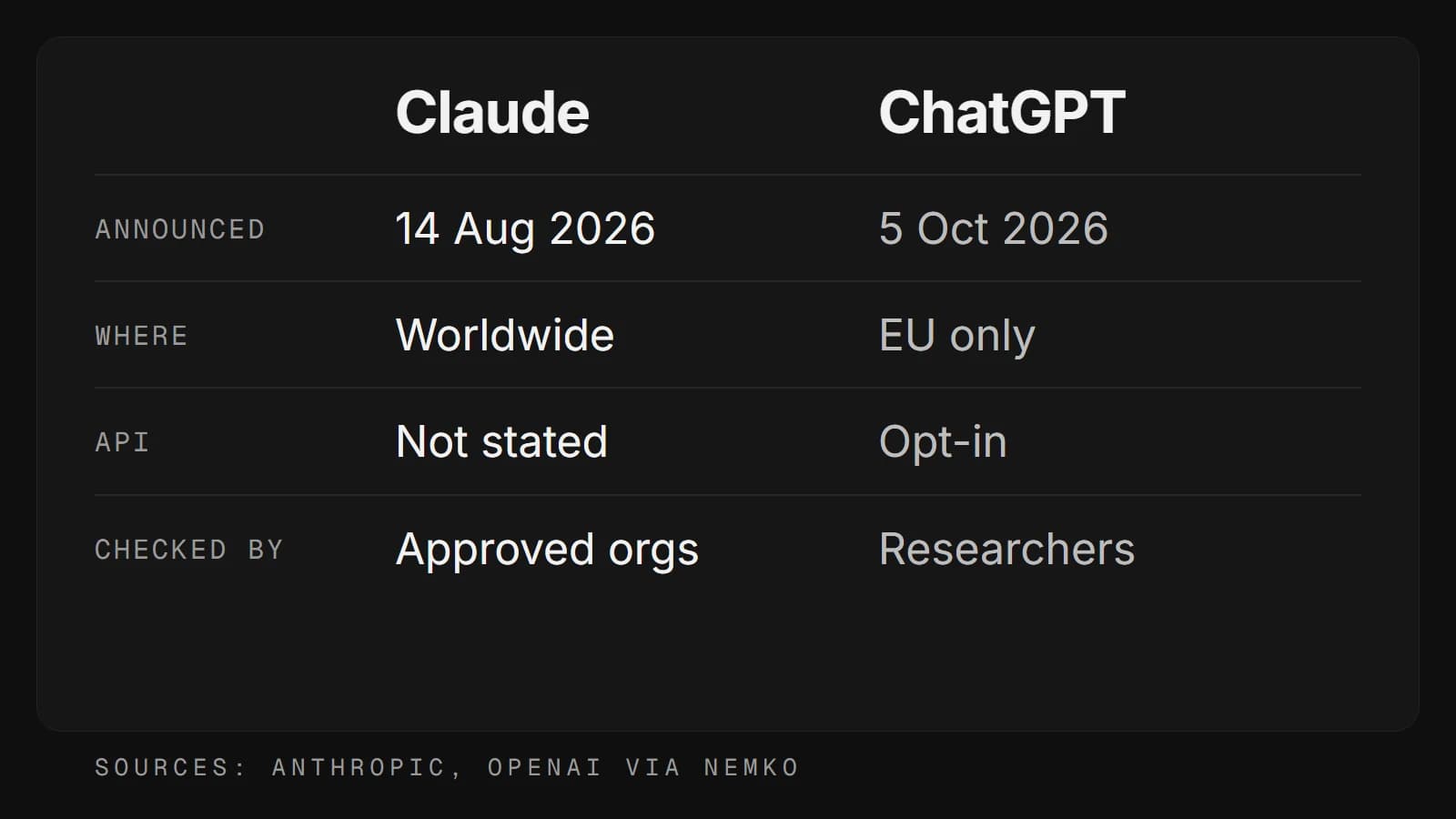
On 14 August 2026, Anthropic announced that its Claude models will write text that carries a watermark. What it said:
- It applies worldwide. Anthropic says it has no reliable way yet to limit it to the EU, so it switched it on everywhere.
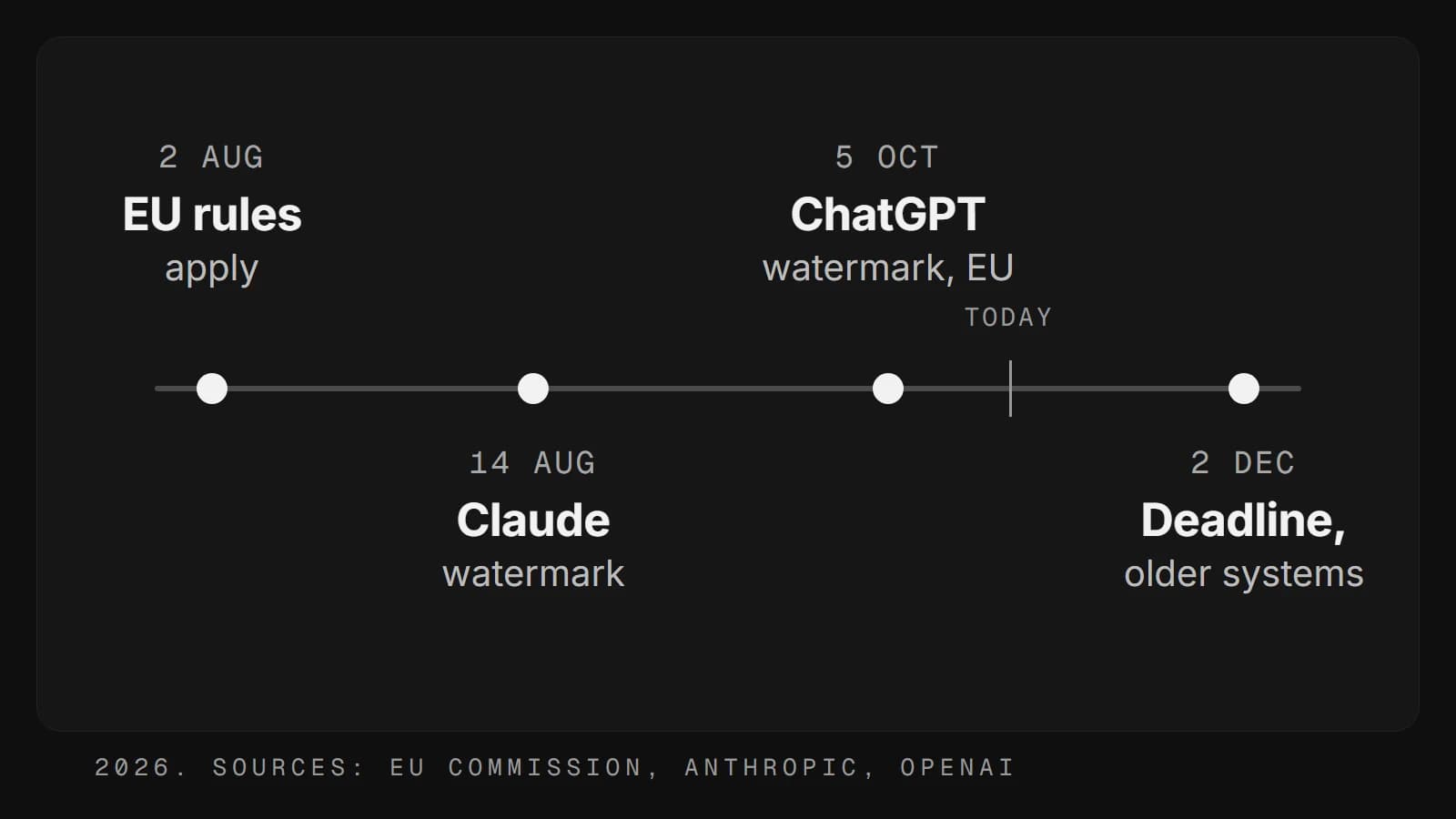
- It starts with newer models. Models released before 2 August 2026 fall under a transition period, and Anthropic says it is working to add the mark to them too.
- Nothing is added to your text: no hidden characters, no invisible spaces. The mark lives in which words Claude picks.
- In Anthropic's own tests it changed nothing about content, creativity or readability.
- Pictures and files Claude creates get something else: a signed content credential (C2PA) in the file's metadata.
Does ChatGPT have a watermark like Claude?
Partly. On 5 October 2026, OpenAI announced a watermark called textGrain for text from ChatGPT and Codex, rolling out over the following weeks. The difference: it is on by default only for users in the EU, on every plan.
- Outside the EU, ChatGPT's text is not marked by default.
- Developers who use OpenAI's API anywhere can switch the watermark on for selected models. It stays off unless they do.
- Like Claude's, the mark sits in the choice of words, not in hidden characters.
How an invisible watermark works
When a model writes, it picks each next word from several that would fit. Normally a little randomness decides between them. A watermark replaces that randomness with a secret key, so the model leans, very slightly, toward certain choices.
One word means nothing. Over a few hundred words, the small leans add up to a statistical pattern. A detector that holds the key can measure it and say how likely it is that the text came from a watermarked model. Without the key, the text is just text.
Claude's version builds on SynthID-Text, a method Google DeepMind published in 2024. OpenAI calls its own version textGrain.
Why now: the EU AI Act
Both companies point to the same rule. Article 50 of the EU AI Act says that the providers of AI systems that generate text, pictures, audio or video must mark the output in a machine-readable way, so it can be detected as AI-generated, as far as that is technically feasible. The rule applies from 2 August 2026.
It also reaches companies outside the EU when their AI is used in the EU. AI systems that were already on the market before 2 August have until 2 December 2026 to add the marking. About 190 companies and organisations signed the EU's voluntary code of practice on marking AI-generated content.
What a watermark can show, and what it can't
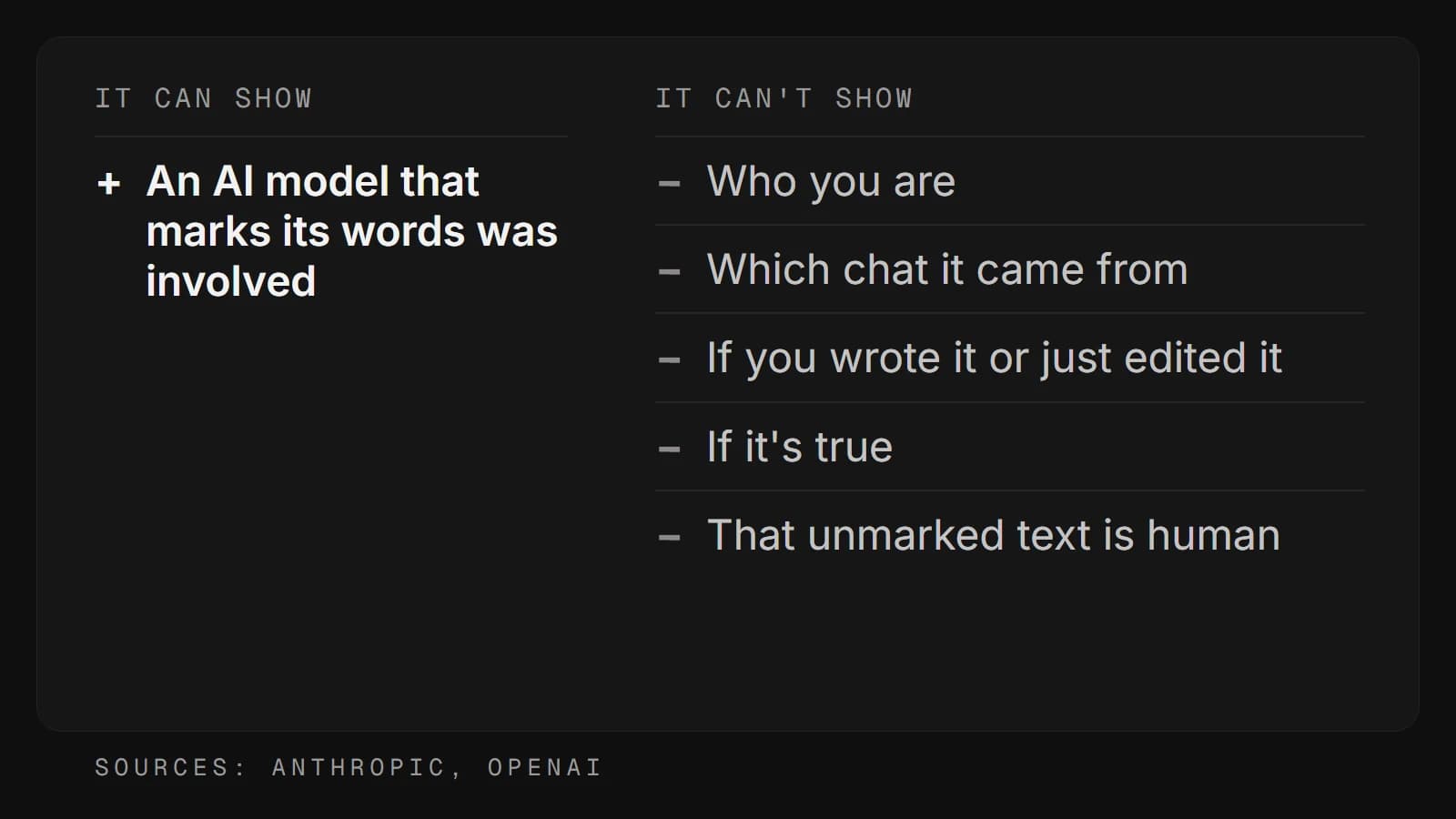
This is the part that matters most. A watermark is not a fingerprint of you.
- It carries nothing about who you are. Anthropic says its mark can't be traced to a person, an organisation or a chat.
- It can't tell whether you wrote the text and only had it edited. In Anthropic's words, it cannot tell “Claude wrote this” from “Claude heavily edited this.”
- It says nothing about who owns the text, or whether it is true.
- No mark doesn't mean a person wrote it. Many models mark nothing, and the mark fades as text is reworked.
How reliable is it?
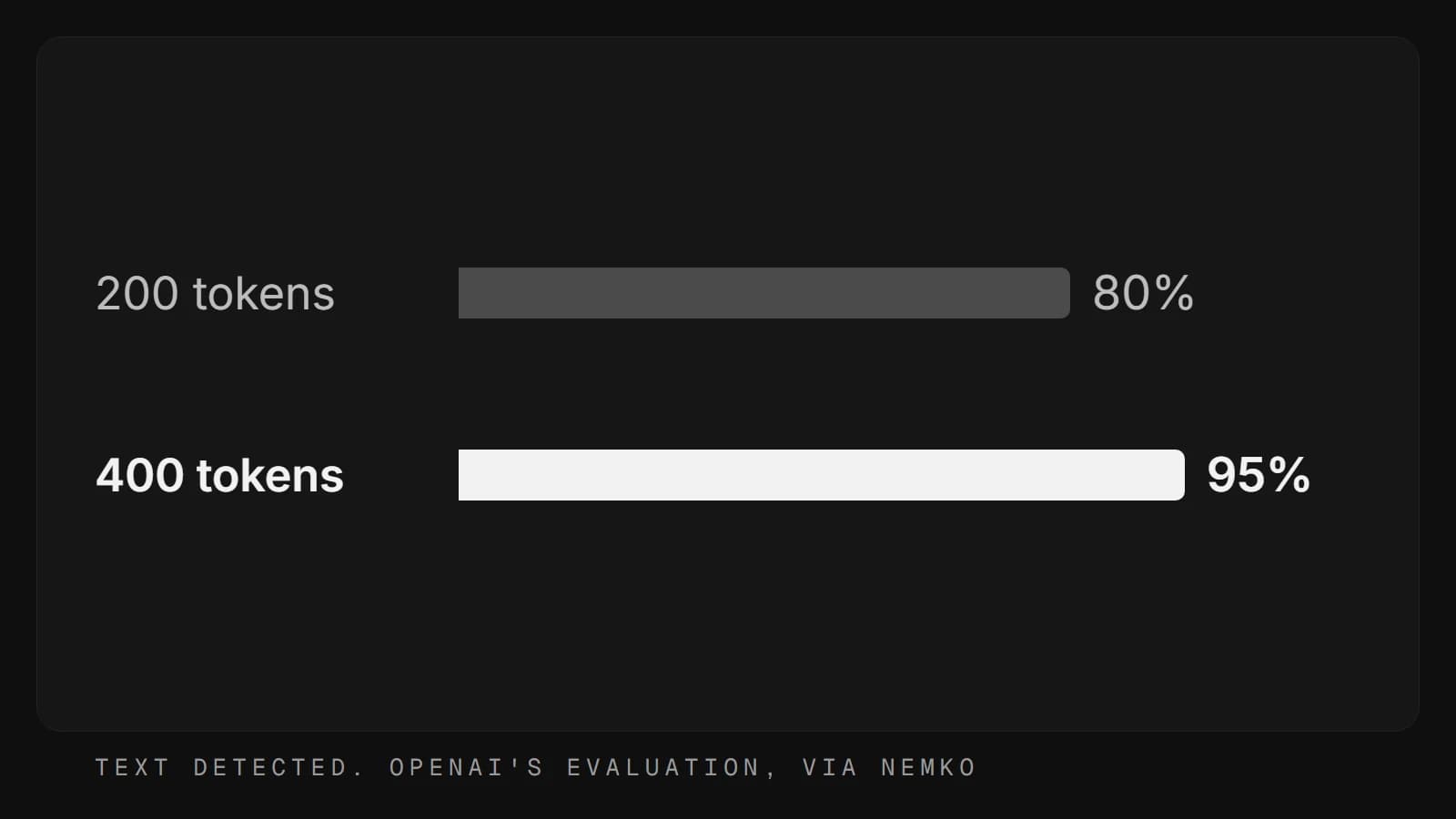
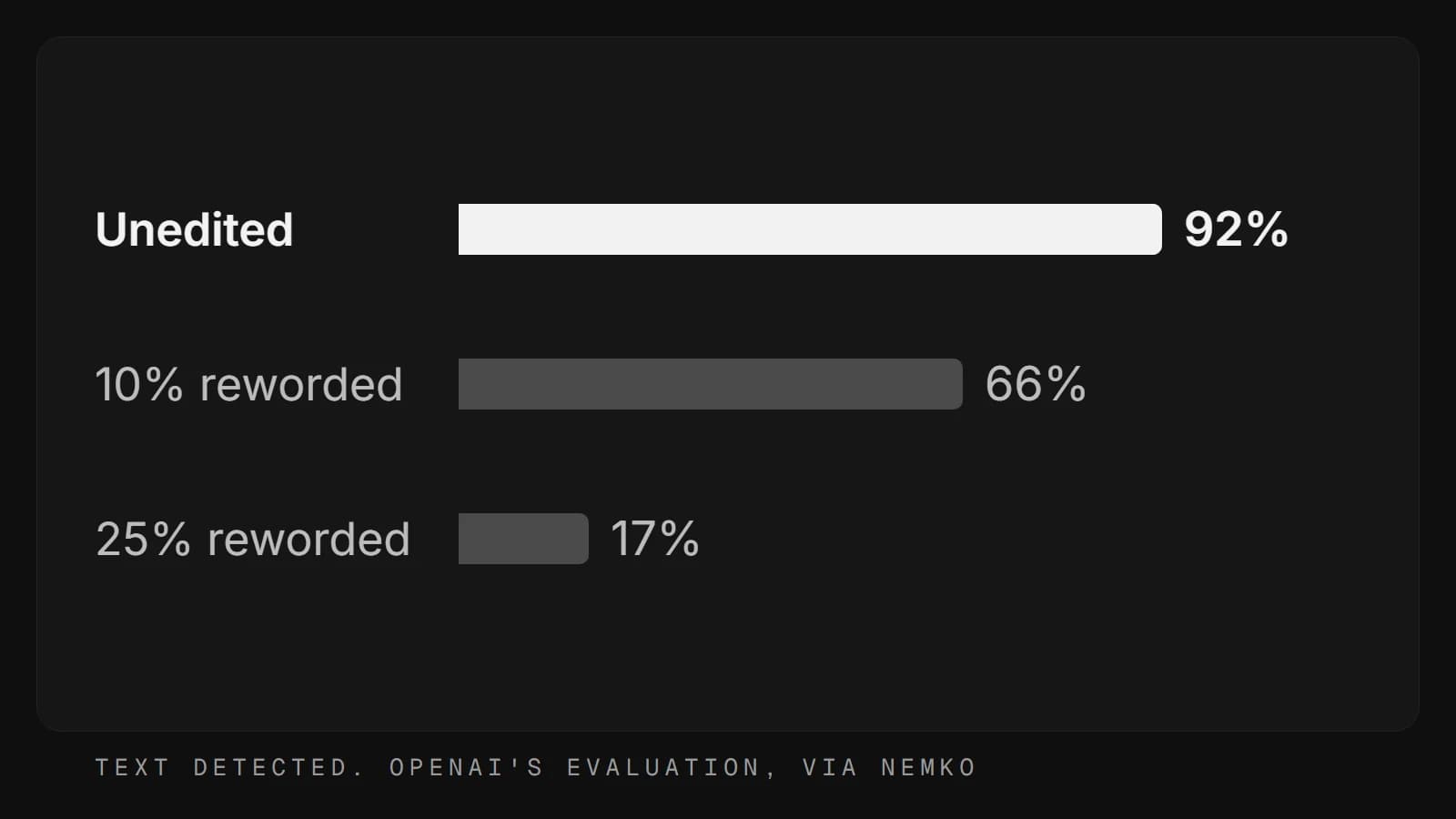
A statistical mark needs enough words. In OpenAI's own evaluation, as reported by Nemko, the detector found the mark in about 80% of 200-token passages and about 95% of 400-token passages, at a 1% false-positive rate. Rewording weakens it: swapping 10% of the words for synonyms cut detection from about 92% to 66%, and swapping 25% cut it to 17%.
So a full essay is easy to check, a two-line reply is not, and text a person reworked sits somewhere in between. That is why both companies call a watermark a signal, not proof.
Who can check your text?
Not just anyone, at least not today. A watermark can only be read with the key, and the keys are not public. Anthropic's detector is a private preview for eligible organisations, as the EU law requires: it names regulators, law enforcement, media, fact-checkers and researchers. OpenAI starts with approved researchers and expert organisations. Both say access will grow, so read this as the state of October 2026, not as a promise.
What this means for you
- If you use AI for work or school, follow the rules you are under. A watermark doesn't change them; it only makes AI text easier to spot when someone checks.
- Editing your own writing with Claude can leave a mark on the parts it rewrote, even when the ideas are yours. Keep your drafts and notes: they show your own work better than any detector.
- Don't read too much into a result either way. A found mark says an AI model was involved, not how much; a missing mark proves nothing.
Watermarks in PocketPhantom
In PocketPhantom you choose the model for each message: our uncensored models, Claude or GPT, in one account. A text watermark lives in the model, not in the app around it, so when a Claude model marks its words, it does so in PocketPhantom too, the same as anywhere else.
Your chats stay in your account on servers in Switzerland until you delete them, and we do not train models on what you write. The privacy policy has the details.
Plans start at $20 a month. Compare the plans, or read about every model.